Sin #1: Treating Cleaning as Housekeeping, Not Process Control
One of the most fundamental errors is viewing cleaning as a basic maintenance task rather than a controlled process.
Consequences include:
- Inconsistent execution
- Lack of validation
- Poor documentation
- Reduced accountability
Cleaning must be treated with the same rigor as production operations, with defined procedures, monitoring, and continuous improvement.
Sin #2: Overreliance on Disinfectants Without Proper Technique
Facilities often assume that using strong disinfectants guarantees contamination control.
These considerations also affect contamination control:
- Disinfectants do not remove particles
- Poor technique leads to redistribution rather than removal
- Contact time is often not achieved
Mechanical action and proper application are critical for effectiveness.
Sin #3: Ignoring Residue Buildup
Residue accumulation is one of the most overlooked issues in cleanrooms.
Common problems of residue accumulation include:
- Reduced disinfectant effectiveness
- Surface degradation
- Slippery floors
- Misleading visual conditions
Many facilities focus on microbial control while neglecting chemical buildup, which can compromise long-term performance.
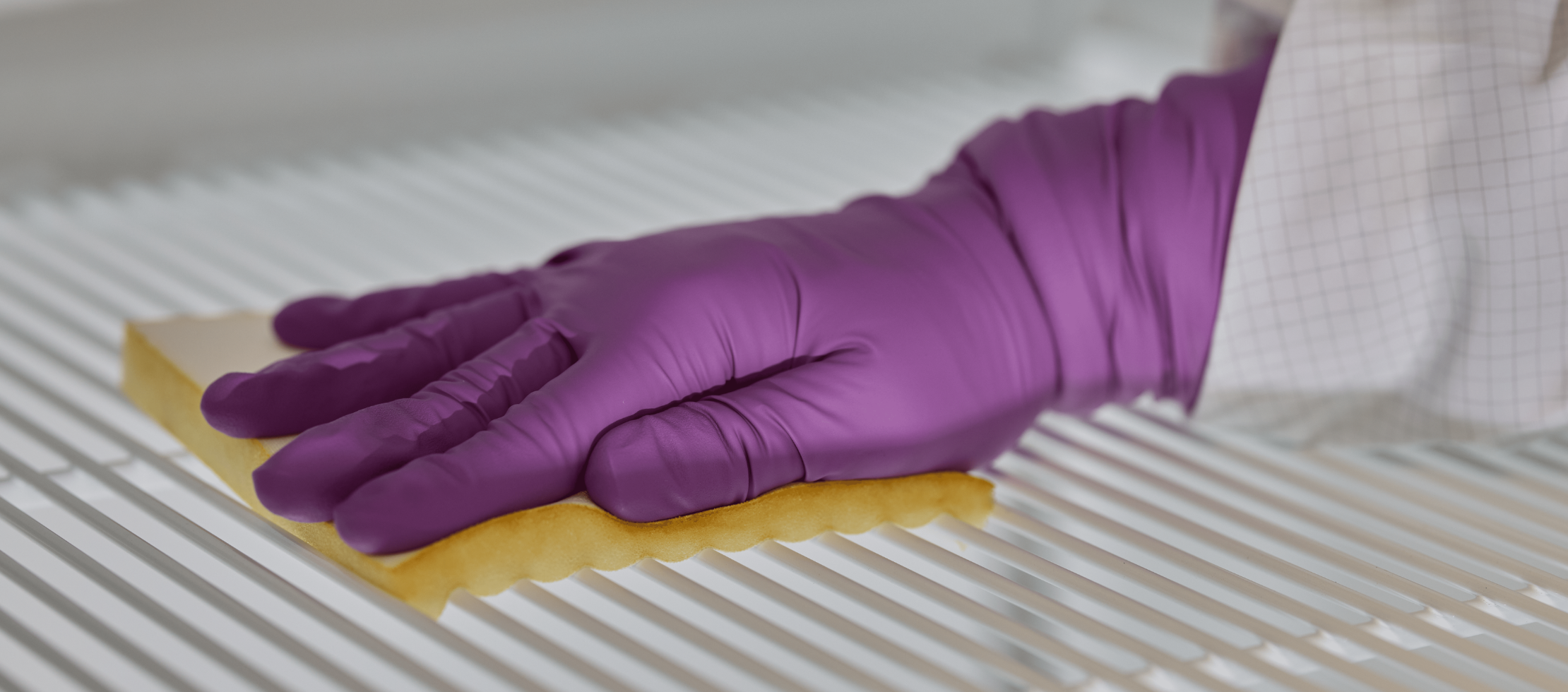
Sin #4: Poor Wiping and Mopping Practices
Improper techniques are widespread and include:
- Circular wiping
- Back-and-forth motion
- Reusing contaminated surfaces
- Inadequate wipe folding
- Failure to maintain a leading edge
These practices redistribute contamination rather than removing it.
Effective cleaning requires:
- Unidirectional strokes
- Overlapping passes
- Frequent wipe rotation
Sin #5: Inadequate Training and Operator Behavior
Even well-designed programs fail without proper execution.
Common issues:
- Insufficient training
- Lack of understanding of contamination risks
- Shortcutting procedures
- Inconsistent technique
Operators are a primary source of variability in contamination control.
Training must be continuous, practical, and reinforced.
Sin #6: Misunderstanding Environmental Monitoring Data
A major misconception is equating acceptable EM results with effective contamination control.
Limitations of Environmental Monitoring:
- Does not detect residues
- Does not assess technique
- Provides only a snapshot
Facilities may appear “in control” while underlying issues persist.
Sin #7: Lack of a Holistic Contamination Control Strategy
Many organizations lack an integrated approach.
Common gaps:
- Disconnected procedures
- Lack of risk assessment
- Poor alignment with regulatory expectations
- Failure to integrate cleaning, monitoring, and training
A robust contamination control strategy (CCS) must connect all elements into a cohesive system.
Panel Insights and Real-World Lessons
The panel emphasizes that these “sins” are not rare—they are common across industries.
Key observations:
- Most facilities experience multiple issues simultaneously
- Problems often persist for years without recognition
- Small deviations in technique or process can have large impacts over time
The discussion reinforces the importance of continuous evaluation, training, and process discipline.
 Contec Cleanroom
 Pharmaceutical Manufacturing, Webinar





 return to overview
 back to top