
From “read and understood” to awareness and a culture of clean.
A perfectly crafted contamination control strategy won’t guarantee contamination control. Not because the documents are wrong, but because documents don’t execute themselves. People do.
You can write meaningful SOPs, policies, and contamination control strategies—complete with layered controls designed to keep the cleanroom and process in a state of control. But each layer of the “house of contamination control” relies on people to execute it. If the inhabitants don’t truly understand what they’re doing (and why), even the best-designed system can get “trashed.”
That’s why cleanroom operator training can’t live or die by “read and understood.” The goal isn’t just completion—it’s awareness, ownership, and consistent execution.
Compliance Isn’t a Substitute for Culture
Compliance is necessary. It sets the framework and establishes control. It’s the rules, regulations, policies, and procedures that define expectations.
But compliance alone isn’t enough for long-term stability. A strong contamination control program needs something deeper: a culture of clean.
Culture creates motivation and commitment. It creates engagement and ownership. It guides behaviors and decision-making even when the SOP doesn’t explicitly cover the moment. In other words, when no one is watching.
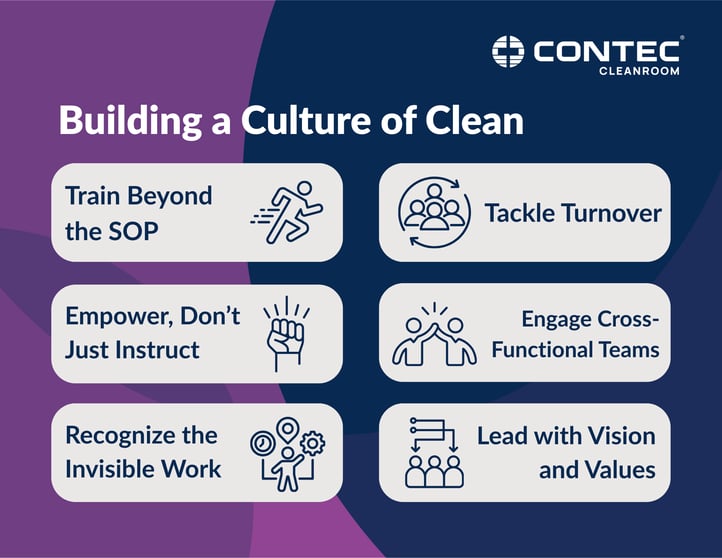
A culture committed to contamination control starts with awareness.
And awareness isn’t just telling operators what to do. It’s ensuring they understand why they’re doing it—so they can make better decisions, recognize risk, and avoid “going through the motions.”
Learn When to ACT
Training Isn’t Automatically Education
A common trap in cleanroom operations is assuming that training completion equals understanding.
“Read and understood” may check the compliance checkbox, but it doesn’t reliably produce in-depth education, awareness, or accountability. Training someone to go through the motions doesn’t mean they fully comprehend what they’re doing and why they’re doing it.
That gap matters, because when training is treated as a checkbox exercise, the organization may get speed—but it doesn’t get capability. The real question is: what value did the training add to the organization?
If the goal is knowledge and skill that can be applied on the job—day in and day out—then training has to move beyond “I read a ninety-page SOP.”
Why Adult Learning Theory Matters in the Cleanroom
Adult learners aren’t kids. They want context. They want relevance. They want to know the “why.” And if you don’t provide the why, they’ll fill in the blank themselves—and apply their own risk assumptions.
That’s exactly why adult learning theory maps so well to cleanroom operator training: it offers practical tools for building awareness and improving performance.
Two learning theories that may be particularly relevant to cleanroom operations are behaviorism and cognitivism. Together, they help training move beyond box-checking and toward real understanding. Learn more about these training theories in our blog.
For more information about training techniques, watch our webinar: https://cleanroom.contecinc.com/train-to-retain-decreasing-cleanroom-turnover